
Circuit Breaker Keeps Tripping in Kuwait? 6 Causes and What to Do

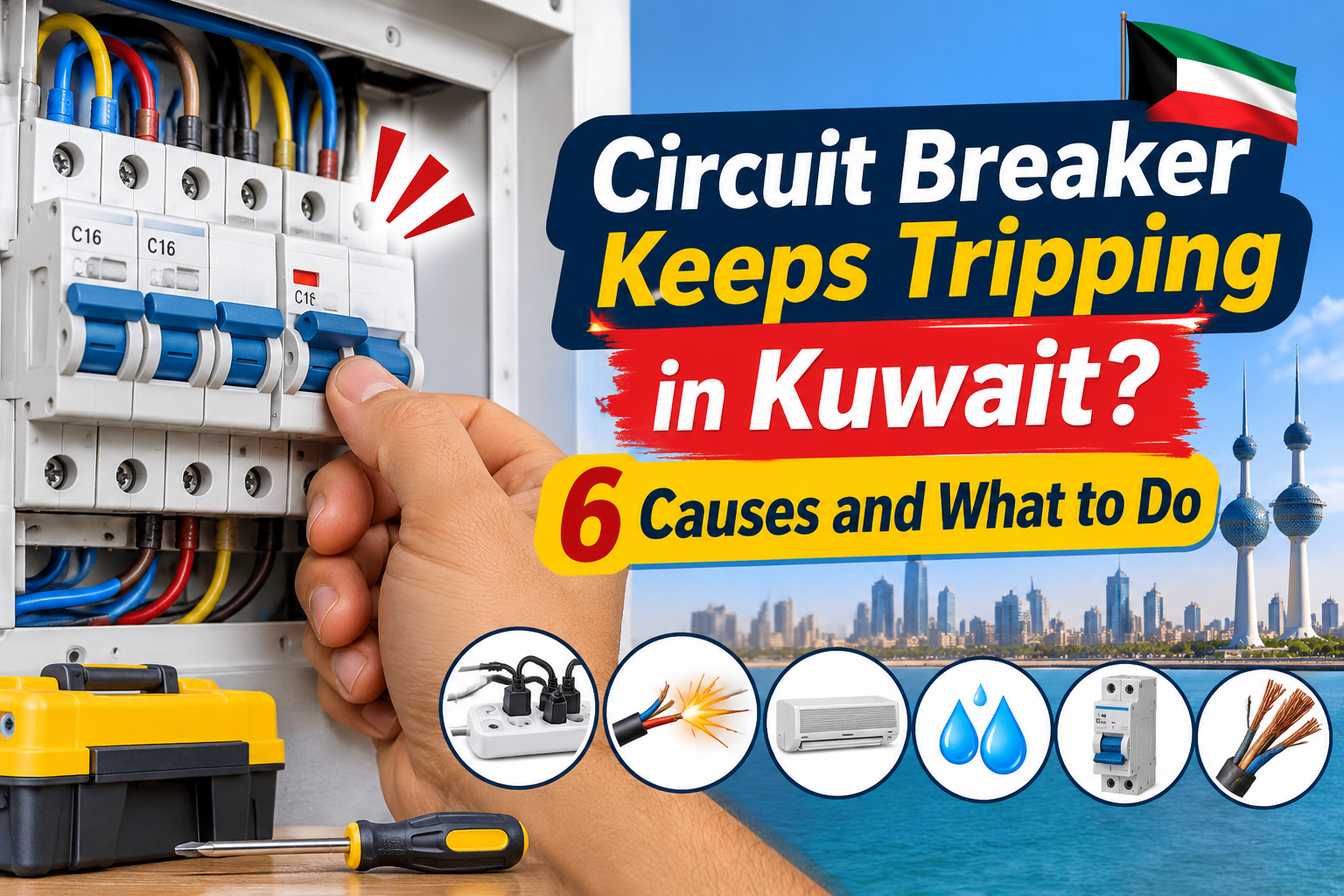
Your circuit breaker keeps tripping because it is detecting something unsafe: too much current (an overload or short circuit) or current leaking to earth (an earth fault). It cuts the power before your wires overheat. In Kuwait homes and shops, the most common cause is an overloaded circuit, often from air conditioners running flat out in summer. Loose wiring, a faulty appliance, or a worn-out breaker come next.
A breaker that trips once after you plug in a heater is normal. A breaker that trips again and again is a warning. Resetting it over and over only forces a protective device to fight a problem that is still there.
At Aamer Kuwait Electrician, our Khaitan-based team handles tripping breakers for homes, villas, shops and restaurants across Kuwait. This guide explains each cause in plain language, what you can safely check in three minutes, and the point where you should stop and call an electrician in Kuwait.
What a Tripping Breaker Actually Means
A circuit breaker is a safety switch. Every circuit in your home is rated for a maximum amount of current. If more flows through the wire than it can safely carry, the wire heats up. Left alone, that heat can melt insulation and start a fire.
The breaker watches for this. When it senses danger, it “trips” (switches off) in a fraction of a second. So a trip is not the fault itself. It is the alarm. The real question is what triggered it, and that usually falls into one of six causes.
Why Does My Circuit Breaker Keep Tripping? 6 Causes
1. Overloaded Circuit
Too many devices are drawing power from one circuit at the same time.
This is the most common cause. Each circuit has a limit. If you run an AC, a water heater, a microwave and an iron on the same line, the total demand can pass that limit and the breaker trips.
Signs of an overload:
- The breaker trips only when several devices run together
- It trips after a few minutes, not instantly
- The breaker or the wall socket feels warm
Fix: Spread heavy appliances across different circuits, and avoid running several high-power devices on one extension board. If your home keeps hitting the limit, the wiring may need an upgrade. See our electrical repair and rewiring service.
2. Short Circuit
A live wire touches a neutral wire, so current surges through an unintended path.
A short circuit causes a sudden, very large rush of current. The breaker usually trips instantly, often with a loud click, and may trip again the moment you reset it.
Common triggers include damaged cable insulation, a faulty socket or switch, a damaged appliance cord, or water getting into a fitting. You may notice a burning smell, scorch marks, or a small spark.
Fix: Do not keep resetting. Unplug everything on that circuit and, if the breaker still trips with nothing connected, the fault is in the wiring and needs a professional.
3. Earth (Ground) Fault
Current is leaking from a live wire to earth, or through something it should not touch.
An earth fault happens when a live wire contacts a grounded part, such as a metal casing, a conduit or damp material. It is common in wet areas like kitchens, bathrooms and outdoor sockets. In homes with an RCD or earth-leakage breaker, this is the device that trips.
Earth faults matter because leaking current can pass through a person who touches the faulty appliance. US fire-safety research (NFPA data, which is US-based) lists short circuits and ground faults among the leading factors in electrical distribution equipment fires. The pattern is a warning wherever it applies.
Fix: Unplug appliances one at a time and reset. If the breaker holds after you remove one specific appliance, that appliance is the culprit. If it trips with nothing plugged in, call an electrician.
4. Why Does My AC Keep Tripping the Breaker? (Kuwait Summer)
An AC draws a large surge of current when it starts, and in Kuwait’s heat it works harder and longer, which can push a marginal circuit over its limit.
Air conditioners are the number one reason for repeat tripping in Kuwait. Several things can cause it:
- Start-up surge: The compressor pulls much more current for a moment when it turns on than when it is running.
- Shared circuit: The AC is on a circuit that also supplies other loads.
- Dirty filters or coils: The unit strains and draws more current.
- Low refrigerant or a failing compressor or capacitor: The unit works harder than it should.
- Undersized breaker or cable: The circuit was never rated for the unit installed.
Fix: Clean or replace the filters, and make sure the AC has its own dedicated circuit. If the breaker trips the moment the compressor starts, the problem may be inside the AC itself, and an AC technician is the right person to call. We will tell you honestly if the electrical supply is fine and the fault is in the unit.
5. Loose or Damaged Wiring
Worn, loose or poorly joined wires create heat and unstable connections that trip breakers.
This is common in older villas and flats where the wiring has aged or was extended over the years without a proper upgrade. Heat and dust in Kuwait speed up the wear on insulation.
Look out for flickering lights, sockets that are discolored or loose, crackling sounds, and a faint burning smell. Loose connections are dangerous because they get hot without always tripping the breaker.
Fix: This is not a DIY job. Wiring faults need testing and repair by a qualified electrician, and sometimes partial or full rewiring. Hidden wiring problems cannot be judged by eye alone.
6. Worn-Out Breaker or Distribution Board
The breaker itself can fail, tripping too easily or too often even when the circuit is fine.
Breakers are mechanical devices. After years of use, heat and repeated tripping, they can weaken and trip below their rated load. Loose connections inside the distribution board, rust, or heat marks around the breaker are also signs of trouble.
If the breaker is old, feels hot, or keeps tripping with no obvious load, it may be the weak link. Replacing only the breaker can help, but in older boards it is often safer to replace the whole board. We handle distribution board replacement and can test the circuit first to confirm what is actually failing.
Why It Gets Worse in a Kuwait Summer
Many customers tell us the problem appears only in summer. That is not a coincidence.
- Heat raises demand. With temperatures reaching around 50°C, ACs run almost non-stop, and every home on your street is doing the same.
- Peak load stresses the grid. Local reports regularly describe record electricity demand during Kuwait’s hottest weeks, and a heavily loaded network can make supply less stable.
- Heat stresses equipment. Breakers, cables and joints work closer to their limits when the surroundings are already hot, so a marginal connection that was fine in winter starts to fail.
- Dust and humidity add wear on switchgear and connections.
In short, summer does not create most electrical faults, it exposes them. A circuit that was barely coping in winter can trip daily at the peak of July.
What You Can Safely Check in 3 Minutes
You do not need to open anything. Try these steps in order:
- Note when it trips. Is it when the AC starts, when you use a certain appliance, or at random? This clue helps the electrician.
- Unplug everything on that circuit. Include extension boards and chargers.
- Reset the breaker once. Push it fully to OFF first, then back to ON. If it trips instantly with nothing plugged in, stop. The fault is in the wiring or the breaker.
- Plug devices back in one by one. If the breaker trips when a particular appliance is connected, that appliance is faulty or too powerful for the circuit.
- Check for warning signs. A warm or discolored socket, a burning smell, or a buzzing sound means stop using that circuit now.
Do not open the breaker panel yourself. The inside of a distribution board carries live parts, even when one breaker is off.
When to Stop Resetting and Call an Electrician
Call a professional right away if you notice any of the following:
- The breaker trips immediately every time you reset it
- A burning smell, smoke, sparks or scorch marks
- A breaker, socket or the panel feeling hot to touch
- Tripping with nothing plugged in
- Flickering lights together with tripping
- A tingling or shock when touching an appliance or switch
- The same breaker tripping repeatedly over several days
If there is a burning smell, visible sparks or smoke, switch off the main supply if it is safe to do so, keep away from the area, and call for help. Do not wait for the next trip.
Our team can isolate the faulty circuit, test it, check connections and the board, and tell you what is wrong before any work starts. You get a quote first, and we explain what is needed and what is not. You can call or WhatsApp us at any hour, and learn more about our team before you decide.
Homes vs Shops and Restaurants: What Changes
The causes are the same, but the risks and priorities differ.
In homes and villas, the usual culprits are overloaded socket circuits, AC loads, older wiring and moisture in kitchens and bathrooms. The main concern is safety and comfort, so repeated tripping should be investigated early, especially in older buildings.
In shops, cafes and restaurants, the load is heavier and more continuous: refrigeration, fryers, ovens, display lighting, coffee machines and multiple ACs. A tripping breaker here means lost stock, lost sales and sometimes a closed kitchen. Commercial circuits often need properly sized dedicated lines, balanced loads across phases, and regular inspection of the distribution board. Overloaded multi-plug adaptors in a busy kitchen are a frequent hidden cause.
If your business trips breakers during peak hours, treat it as a load-planning problem, not just a repair, and ask for an inspection before the next busy season.
FAQ
Is it dangerous if my breaker keeps tripping?
It can be. Occasional tripping from an overloaded circuit is a nuisance, but repeated tripping can point to a short circuit, an earth fault or damaged wiring, which can cause overheating or fire and shock risk. If it keeps happening, have it inspected.
Why does my breaker trip with nothing plugged in?
If it trips with nothing connected, the fault is likely in the fixed wiring, a socket or switch, moisture in the system, or the breaker itself. This is not something to troubleshoot at home. Call an electrician.
Why does it trip when the AC turns on?
Most often it is the AC’s start-up surge on a circuit that is already heavily loaded or undersized. Other causes include a dirty unit, a weak capacitor or compressor, or loose connections. If the electrical side tests fine, the AC may need an AC technician.
Can a faulty appliance cause repeated tripping?
Yes. A damaged cord, a failing motor or heating element, or water inside an appliance can cause overloads or earth faults. If the breaker only trips when one appliance is plugged in, stop using it and have it checked or replaced.
Will a surge protector stop it?
No. A surge protector guards equipment against voltage spikes, but it does not fix an overload, short circuit or earth fault. Plugging more into a surge strip can make an overload worse.
Conclusion
A circuit breaker that keeps tripping is telling you something. The cause may be as simple as too many devices on one circuit, or as serious as damaged wiring or a failing board. In Kuwait’s summer, the heat and heavy AC use turn small problems into daily ones.
Check what is safe to check, never open the panel, and stop resetting once the breaker trips straight back. If you need help, Aamer Kuwait Electrician is here 24/7 across Kuwait.