
Building a House in Kuwait? 7 Wiring Decisions You Can’t Fix After Plastering

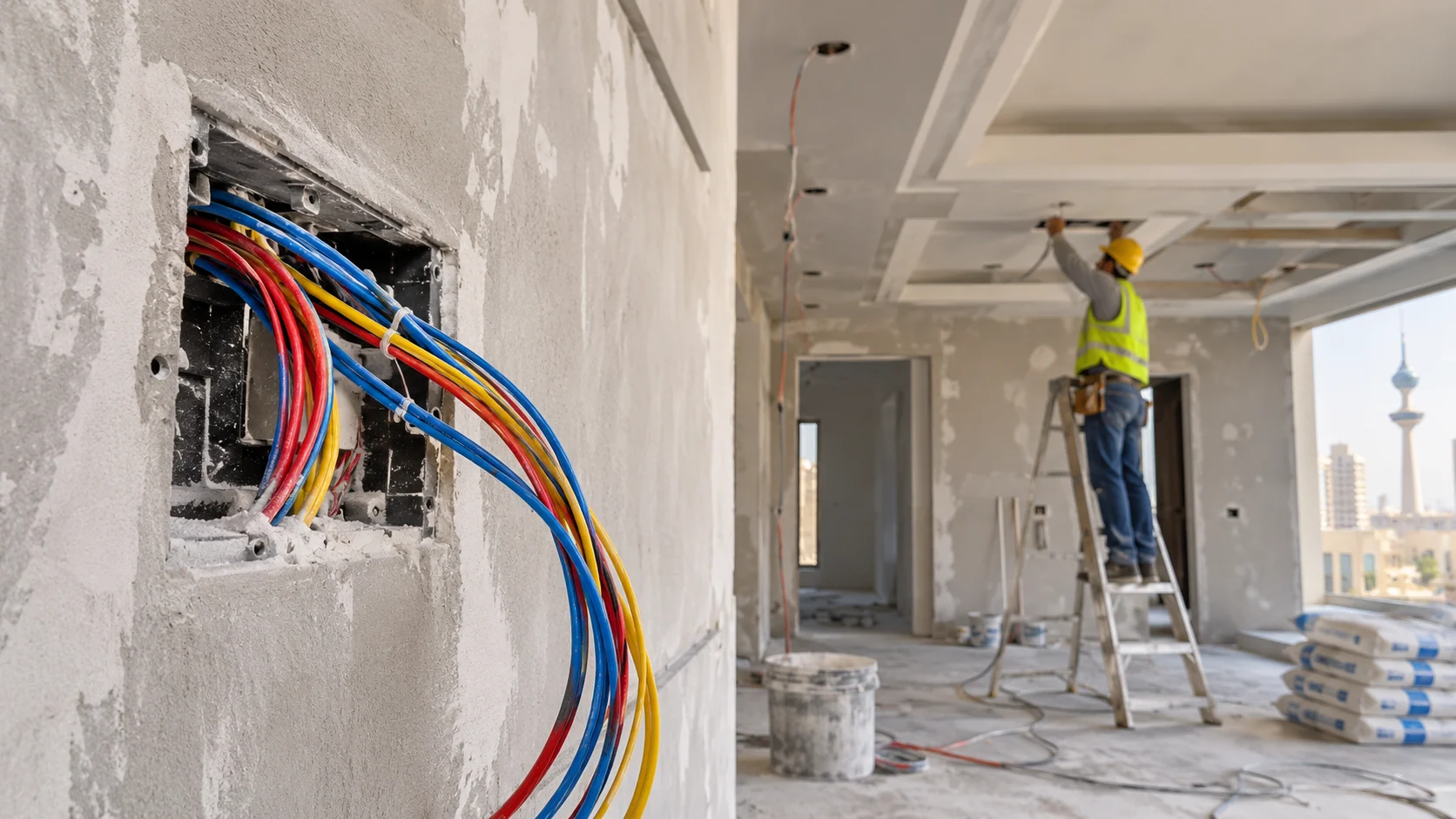
Here’s how it usually goes. The villa is plastered, the tiles are down, and the owner is standing in the majlis asking, “Where’s the TV socket?” Nobody planned one there. Now it’s a chisel, a lot of dust and another coat of paint.
Electrical wiring for new construction is the one job in a build you only get to do properly once. After the walls close, every change costs more time, more money and more patience than it ever should have.
We’re Aamer Kuwait Electrician, a Khaitan-based team that works on homes, shops and building sites across Kuwait, 24/7. This guide walks you through what happens at each stage, how the approval path works, and the seven decisions to make before the plaster goes on. It’s the checklist we’d want a friend to have before building.
What is electrical installation in building construction?
Electrical installation in building construction is everything involved in planning, fitting and testing the parts of a new building that carry power: cables, conduits, the distribution board, earthing, sockets, switches and lights. It starts on paper and ends with a tested system that’s safe to switch on.
The work happens in phases, around the other trades. The early phase, often called rough-in or first fix, happens while the walls are still open. That’s when the crew is drilling, running cable and fixing boxes. The finishing phase, second fix, comes after plaster and tiles, when sockets, switches and light fittings go on.
That split is why timing matters so much. Anything that lives inside a wall or ceiling has to be decided before first fix. Everything you can see on the surface is easier to swap later. You can see what we install on our electrical works page.
Electrical wiring for new construction, stage by stage
Every project is a bit different, but electrical wiring for new construction follows the same five stages.
Stage 1: Planning, drawings and load
The electrical drawings show where every point, circuit and the distribution board (DB) will go. Next to them sits the load calculation, which is just adding up what the building will draw once people live in it: AC units, water heaters, kitchen appliances, lighting. Get this wrong and you’ll be fighting tripping breakers in the first hot week. It’s also the cheapest stage to change anything, because nothing has been drilled yet.
Stage 2: First fix
Conduits and boxes go into walls, floors and ceilings, and cables are pulled through. It’s noisy, messy and it looks like nothing is happening. But this is where the real quality is decided, because all of it disappears behind plaster. Cable routes, box positions and joints should be checked before anything gets covered.
Stage 3: The distribution board and earthing
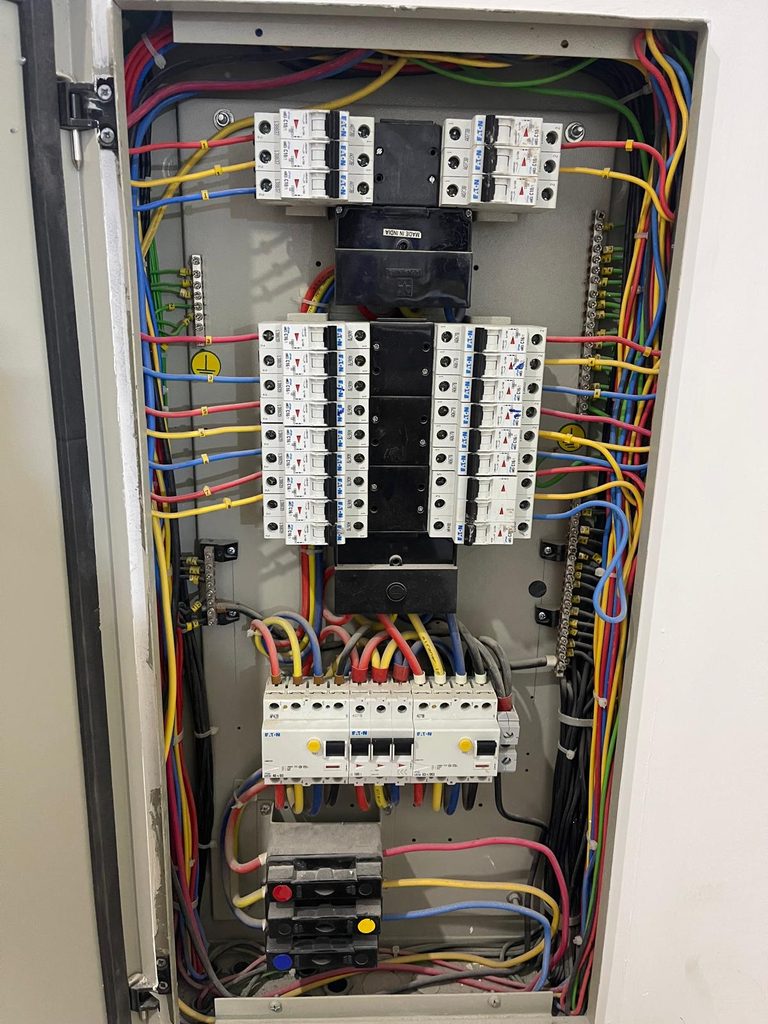
The DB is the heart of the system. It holds the breakers that protect each circuit. Earthing gives a fault a safe path to the ground, so a leak in an appliance trips a breaker instead of shocking someone. Size the board with spare room for future circuits. More on that below.
Stage 4: Second fix
After plaster and tiles, the sockets, switches and lights are fitted. This is the part you see, so it’s the part owners notice. If something looks off here, it often traces back to a decision that was skipped in stage 1.
Stage 5: Testing and connection
Before the supply goes live, the installation is tested. The building gets checked too: Kuwait Municipality inspects the finished building against the approved drawings before it issues a completion certificate. So what’s on the drawings should be what’s in the walls.
The approval path in Kuwait: who does what
In Kuwait, electricity isn’t something you can leave to the end of the paperwork. Under a 2012 Kuwait Municipality circular, no building permit can be granted until the Ministry of Electricity and Water (MEW) approves the electricity supply arrangement, and a site inspection happens before that approval. The official steps for private housing are on the e.gov.kw electricity page.
Your consultant or main contractor usually files the drawings and the MEW submissions. If you’re not sure who’s doing it on your project, ask before work starts. Our part is the wiring itself, built to match what was approved.
Can I wire my new construction house?
In practice, no, not the wiring itself. A new build goes through permits, drawings and inspections, and wiring that ends up inside your walls is a bad place to learn on the job. If you want the exact rule for owner-done work, ask MEW or Kuwait Municipality directly.
What you can do is the planning. Walk through the plan room by room, mark where you’ll want sockets, switches and lights, and bring that to your electrician. Owners who do this save everyone a lot of back and forth.
7 wiring decisions to settle before the plaster goes on
These are the choices that hurt most when you try to change them later. Settle them with your electrician and your interior designer before first fix. Electricians who work on new builds keep naming the same costly mistake: treating the electrical plan as something to figure out along the way.
1. How many sockets, and exactly where
Add more than you think you need, and put them where you’ll actually use them. Stand in each room with your furniture plan and ask where the TV, the bedside tables, the desk and the vacuum will be. Think about kitchen counters, behind the sofa, long corridors and outdoor sitting areas. A socket you never use costs almost nothing. A socket you need later means opening a wall.
2. Which things get their own circuit
Give every AC unit its own circuit, and do the same for the water heater, the oven and the washing machine. When appliances share a circuit, one heavy start-up can knock everything else off. Not planning enough dedicated circuits is one of the most common new-build mistakes, and in Kuwait it matters more, because air conditioners use roughly 70 percent of the electricity consumed.
3. Lights, switches and who controls what
Decide ceiling light positions with your interior designer before first fix, not after. Put two-way switches at the top and bottom of stairs and at both ends of long corridors, so nobody walks in the dark. Think about dimmers for the majlis and living room, and keep outdoor lights on their own circuit. Moving a ceiling point once the slab is closed is a bigger job than it sounds.
4. How big the distribution board should be
Leave spare ways in the DB. You’ll add something sooner or later: another AC, a pump, a car charger. A full board means replacing the board, in a house you’re already living in. It’s a small extra now, and it’s one of the things we’d never skip.
5. What happens when the power goes off
Kuwait started scheduled power cuts for the first time in summer 2024. You can’t control the grid, but you can plan the house. Decide now where a generator would connect, and set aside a group of essential circuits (the fridge, a couple of ACs, key lights) behind a proper changeover switch. It also helps to plan generator readiness during the build rather than adding it later.
6. Outdoors, the majlis, the garage and the pump room
Outdoor and semi-outdoor areas need their own thinking. Garden lights, the gate motor, a water pump and outdoor sockets should sit on separate circuits from the house, with fittings suited to the weather. That way an outdoor fault doesn’t switch off your whole home on a Friday evening.
7. Empty pipes for data, cameras and smart gear
Run empty conduits for the things you’ll add later: CCTV cameras, Wi-Fi access points, intercom, TV points and smart switches. A pipe in the wall costs very little. Pulling cable through finished plaster doesn’t work. If you’re not sure what you’ll want in five years, a few spare pipes between the roof and the DB room are cheap insurance.
Kuwait heat and your cables
Heat is a wiring issue here, not just a comfort issue. Cables are rated for a certain operating temperature, and the hotter the surroundings, the less current they can safely carry. Summer days in Kuwait often pass 50°C, and the ACs run flat out.
So ask your electrician how the cable sizes and routes in your plan account for heat, especially for AC circuits and any runs through hot roof spaces. It’s a good question, because a straight answer shows whether the plan was properly thought through.
Mistakes that fail inspections or cost you later
Inspections catch the boring stuff, and it’s almost always avoidable. Common new-build failures include loose or exposed wiring, overfilled boxes, missing labels on the panel and incorrect earthing. Beyond those, these are the ones we’d watch for:
- Changing the layout after first fix, then patching it with surface cables
- Covering the walls before the circuits are tested
- Leaving the DB unlabelled, which feels harmless until a fault at 2 a.m.
- Saving a little money by going smaller on cable size
- Nobody being clear on who is responsible for what between the consultant, the contractor and the electrician
If you’re at the planning stage, call or WhatsApp us and tell us what you’re building.
Quick answers
What voltage is used in Kuwait?
Kuwait uses 240V at 50Hz. That’s different from the 120V common in the US and Canada, so appliances from those countries need to be dual-voltage or used with a converter.
What type of electrical plug is used in Kuwait?
Type G, the three-pin plug. It’s the standard in most Kuwait sockets, although some reference tables list Type C as well. Tell your electrician which socket type you want, so the wiring devices match.
When does the wiring actually happen during construction?
In two rounds. First fix happens while the walls are open, before plaster, and covers conduits, boxes and cables. Second fix comes after plaster and tiles, with the sockets, switches and lights. Testing and the supply connection come last.
Conclusion
Good electrical wiring for new construction isn’t about fancy materials. It’s about making the right calls early: how many sockets, which circuits, how much spare space, and what happens in a power cut. Settle those before the walls close, match the work to the approved drawings, and the house will feel easy to live in from the very first summer.
If you’re building in Khaitan, Farwaniya, Salmiya, Hawally, Jahra or anywhere else in Kuwait, we’re happy to talk it through., Message us on WhatsApp to Aamer Kuwait Electrician. We’ll give you a quote before any work starts, with no hidden charges. Tell us what stage you’re at and we’ll tell you what to settle next. You can read more about us on our about page.